Belt conveyors
The quiet equipment that decides whether your product arrives at the bagging line whole or as fines. Flake is fragile; a badly designed transfer turns 3 mm product into dust that nobody wants to buy.
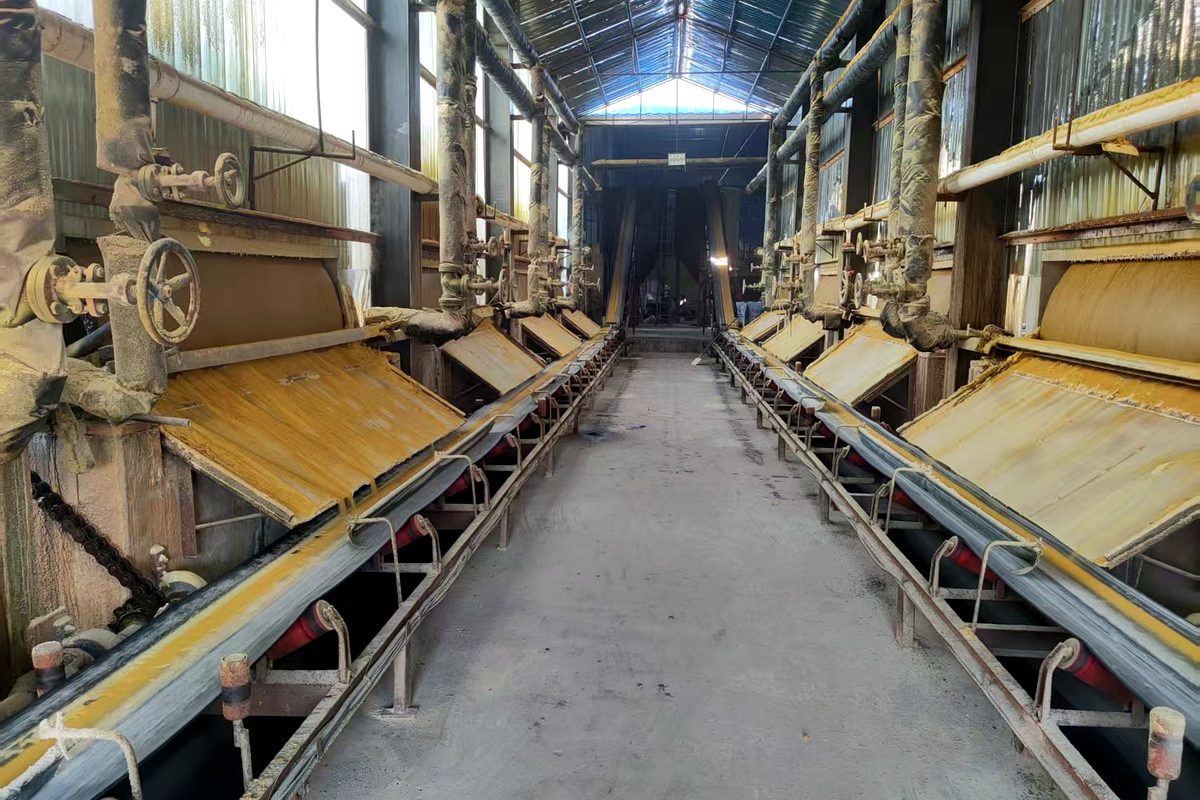
Why conveying deserves design attention
Dried PAC flake is brittle and slightly hygroscopic. Every drop, every tight transfer and every over-fast belt generates fines. Fines mean lower bulk density, more dust in the bagging room, more housekeeping and — at the customer end — more dust when the bag is opened. The conveyor layout is where that is won or lost.
Layout rules we apply
- Belt speed 0.5–1.2 m/s for flake; above that the product slides and abrades
- Incline limited to 18° for flake on a smooth belt, 25° with cleats
- Transfer points kept to a minimum; each one is a drop height and a dust source
- Chute angles of 60° or steeper on the discharge, with a dead-box to cushion the fall
- Full enclosure with inspection doors, connected to the dust extraction header
- VFD on the drive so the belt can be matched to dryer output instead of running empty
Range and specifications
| Model | Belt width | Speed | Capacity | Power |
|---|---|---|---|---|
| GRC-500 | 500 mm | 0.5–1.5 m/s | 6–10 t/h | 2.2 kW |
| GRC-650 | 650 mm | 0.5–1.5 m/s | 10–18 t/h | 3.0 kW |
| GRC-800 | 800 mm | 0.5–1.2 m/s | 18–30 t/h | 4.0 kW |
Capacity at 0.45 t/m³ bulk density on a 20° trough. Horizontal runs carry more; each incline costs roughly 8% of capacity per 5°.
Details that avoid trouble
- 01
Design the whole path at once
Dryer outlet, incline, silo inlet, bagging feed. A conveyor bought to fit a gap between two machines will have a transfer that generates dust.
- 02
Keep the product on the belt
Skirt rubber, a proper loading chute and a belt cleaner at the head pulley. Spillage under a conveyor is a permanent housekeeping cost.
- 03
Provide access for cleaning
Food-grade and water-treatment products both need cleanable equipment. Hinged covers and a removable tail section make a weekly job into an hourly one.
- 04
Interlock with the dryer
The conveyor must start before the dryer and stop after it. A simple interlock saves a burned belt and a floor full of hot flake.
Questions we are asked
Belt or screw conveyor?
Belt for flake, screw for powder and for short horizontal runs. A screw on flake grinds it against the trough and produces fines.
Do we need dust extraction on the conveyor?
On the transfer points, yes. The belt itself is enclosed; the dust comes from drops. Two or three extraction hoods tied into the scrubber fan usually solve it.
Can the conveyor handle both flake and powder?
Physically yes, but not well. Powder fluidises and leaks at the skirts, flake needs a low incline. If you will run both, design for powder and accept reduced capacity on flake.