Drum flaker dryers
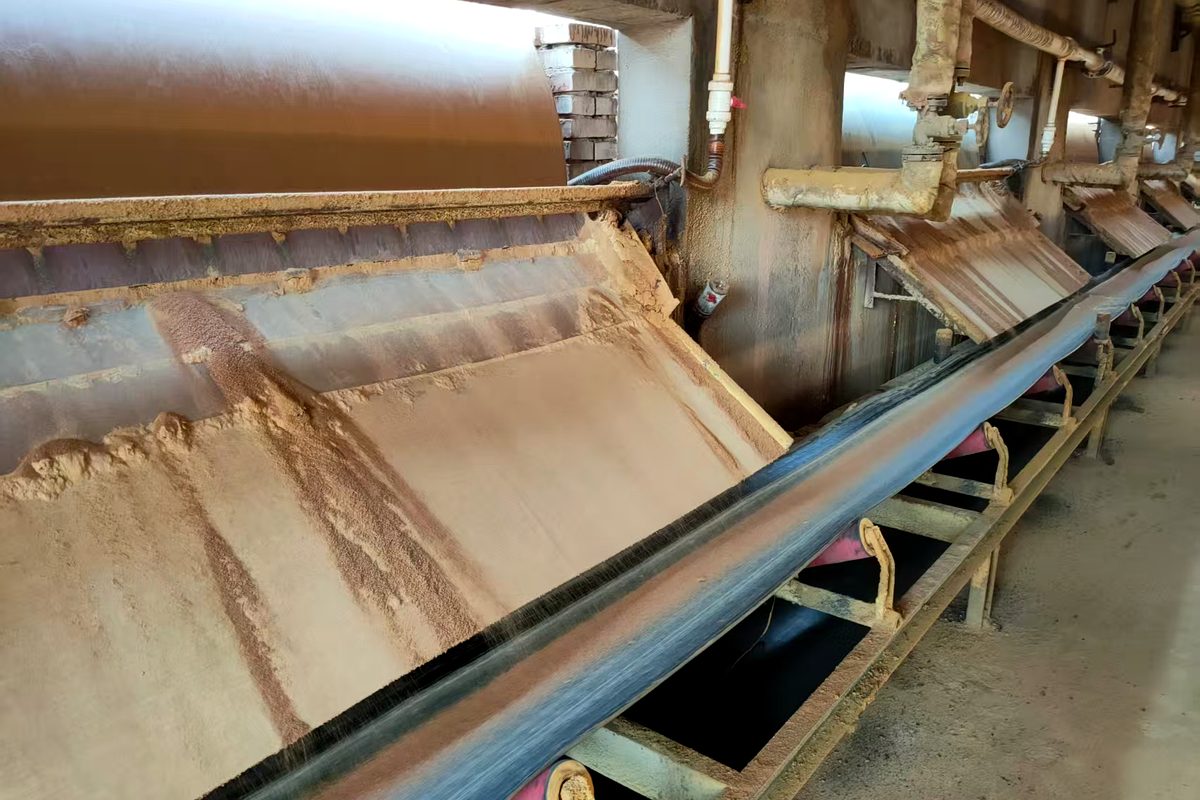
The stage that turns liquid coagulant into a saleable solid. A steam-heated drum dips into the liquor, a film dries on the shell in one revolution, and a knife takes it off as flake. It is simple, robust and — if the film thickness is right — remarkably forgiving.
Where it sits in the line
Clear liquor from the settling stage → feed tank → drum flaker → flake conveyor → silo → bagging. Vapour from the hood goes to the scrubbing tower, which is why the dryer and the tower are designed together rather than bought separately.
The drum turns at 3–8 rpm. A film of 0.5–1.5 mm is applied, dried in roughly three quarters of a revolution, and cut off by a knife running the full drum width. Everything about output is contained in that film thickness and the drum surface area.
Construction
- Drum in Q345R or 16MnR with a ground and chrome-plated shell; internal steam distribution by a syphon or dip tube
- Steam joint with rotary union and condensate trap; a poorly trapped drum runs half full of water and loses most of its capacity
- Knife holder with a micrometer-style adjustment, so the film can be set in 0.05 mm steps
- Hood over the drum connected to the scrubber header, with an inspection door and a drain for condensate
- Screw or belt conveyor beneath the knife, enclosed, with a slight incline to the silo
- Drive through a geared motor with a VFD — speed is the main operating handle
Range and specifications
| Model | Drum | Area | Speed | Evaporation | Output (solid) |
|---|---|---|---|---|---|
| GRD-1.0 | Φ1.0 × 1.2 m | 3.8 m² | 3–8 rpm | ≈120 kg/h | ≈300 kg/h |
| GRD-1.5 | Φ1.5 × 1.8 m | 8.5 m² | 3–8 rpm | ≈280 kg/h | ≈700 kg/h |
| GRD-1.8 | Φ1.8 × 2.2 m | 12.4 m² | 3–7 rpm | ≈420 kg/h | ≈1,050 kg/h |
| GRD-2.0 | Φ2.0 × 2.5 m | 15.7 m² | 3–6 rpm | ≈540 kg/h | ≈1,350 kg/h |
Output assumes 10–12% Al2O3 feed, 0.7 MPa saturated steam and 2–3 mm flake. Two or more drums are normally installed in parallel for continuous output.
What sets the output
- 01
Steam quality before drum size
Wet steam at 0.4 MPa will not do what dry steam at 0.7 MPa does on the same drum. Specify the steam condition and provide a separator and trap station.
- 02
Film thickness is the operating handle
Thicker film means more output per revolution but higher residual moisture. Most plants run 0.8–1.2 mm and adjust to hit the moisture spec, not the tonnage.
- 03
Feed concentration decides everything downstream
Feed at 10% instead of 12% Al2O3 means roughly 20% more water to evaporate for the same product. Evaporate upstream where it is cheaper.
- 04
Two drums beat one big drum
Parallel drums let you take one out for knife changes and cleaning without stopping the line, and they match the batch rhythm of the reactors.
Questions we are asked
Drum flaker or spray dryer?
A drum flaker gives dense, dust-free flake at low capital cost and suits capacities up to about 30,000 t/y. A spray dryer gives a spherical, free-flowing powder with better dissolution and handles much larger tonnage, at roughly three times the capital and a significant fuel demand. We build both and will tell you which fits.
What moisture can we hold?
Two to three per cent is routine. Below 1% the flake becomes brittle and fines generation climbs; the market rarely pays for it.
How is the knife maintained?
It is a wear part. Expect to re-grind or replace every two to four months depending on abrasion. Design the holder so a knife change takes twenty minutes, not a shift.