Vapour hoods & ducting
The hood is where the environmental performance of the whole plant is decided, and it is usually the last thing anyone thinks about. A perfect scrubbing tower connected to a leaking hood does nothing at all.
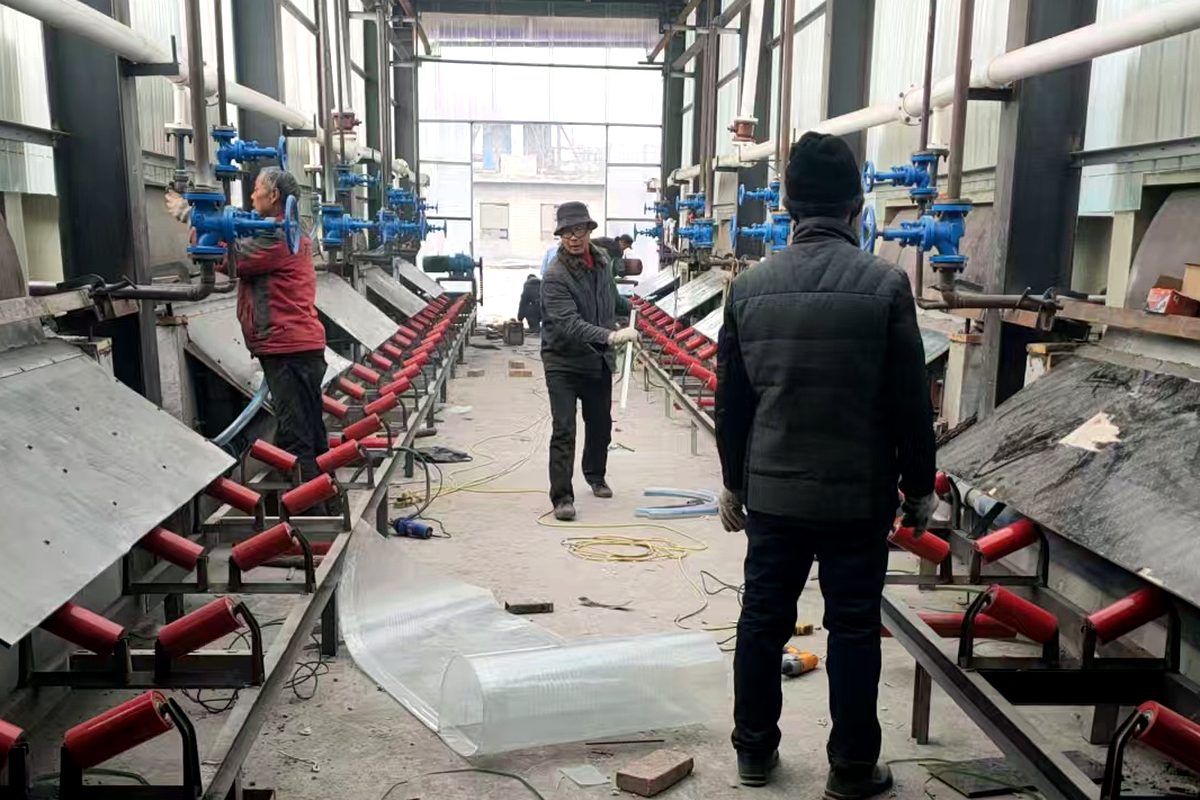
Capture before treatment
Acid mist escapes through the path of least resistance: an open manway, a gap in a hood, an unsealed knife slot. Keeping the dryer enclosure under a slight negative pressure means air flows inward everywhere, and the tower sees everything that is generated. The number to design to is a face velocity of 0.5–1.0 m/s at every opening.
What the system includes
- Hood body in PP or FRP, hinged or removable panels for knife changes and cleaning
- Observation window in tempered glass or clear PVC, positioned where the operator actually looks
- Ducting sized for 8–12 m/s transport velocity — slower drops out mist, faster erodes the bends
- Balance dampers on each branch so one hood cannot starve another
- Drain points at every low spot; condensate is acidic and will find the lowest point
- Fan selected for the whole system at operating temperature, with a VFD to trim flow once the plant is balanced
Typical duct sizing
| Source | Flow | Duct | Velocity |
|---|---|---|---|
| Drum dryer hood (Φ1.5) | 2,500–3,500 m³/h | Φ315 mm | ≈10 m/s |
| Drum dryer hood (Φ2.0) | 4,000–5,000 m³/h | Φ400 mm | ≈10 m/s |
| Reactor vent | 600–1,200 m³/h | Φ200 mm | ≈9 m/s |
| Storage tank vent | 300–600 m³/h | Φ160 mm | ≈8 m/s |
| Bagging point | 1,500–2,500 m³/h | Φ250 mm | ≈10 m/s |
Flows are capture volumes at the hood face, not process gas. Add 15% margin for leakage and future connections when sizing the tower and fan.
Mistakes we see on existing plants
- 01
The hood is open at the top
A hood with a permanent opening short-circuits: the fan pulls room air and the mist goes out the opening. Close it and let the negative pressure do the work.
- 02
Duct runs are long and flat
Horizontal runs collect condensate and dust. Keep them short, slope them back to a drain, and use long-radius bends.
- 03
One fan serves everything with no balancing
The nearest hood takes all the flow and the furthest one takes none. Balance dampers and a commissioning measurement fix this in an afternoon.
- 04
Material chosen for the gas, not the condensate
The gas is dilute; the condensate is concentrated acid. PP and FRP handle both, galvanised steel handles neither.
Questions we are asked
Can we reuse existing ducting?
Sometimes. We survey it for leaks, slope, material and internal condition first. Reusing a corroded duct run with a new tower is a common way to waste a good tower.
How much air does a hood actually need?
Enough to hold 0.5–1.0 m/s at every opening with the hood closed as far as the process allows. It is a capture calculation, not a rule of thumb per metre of hood.
Does the hood need to be insulated?
In cold climates yes, to stop condensation running back onto the product. Elsewhere a drain and a slight slope are enough.