HCl scrubbing towers
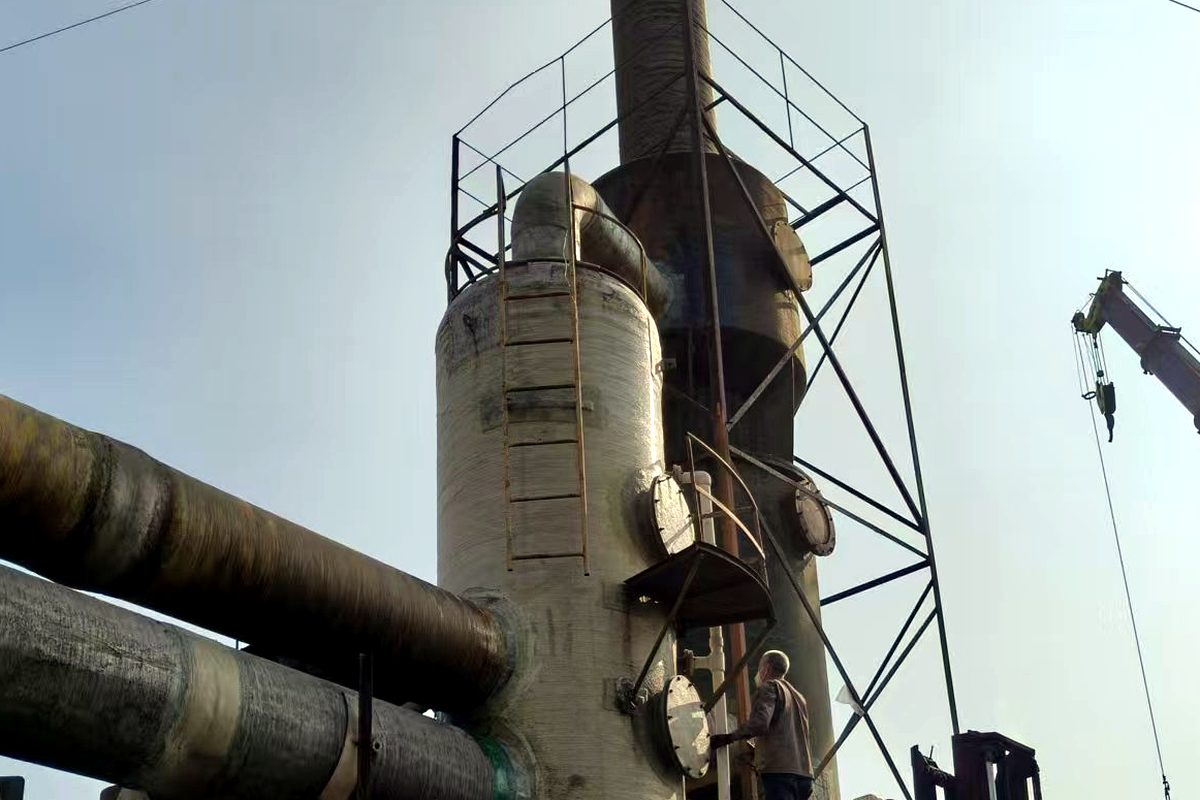
Every acid-route plant emits hydrogen chloride with its water vapour. Whether that becomes a permit problem or a recoverable acid is decided by the absorber design. This is the equipment permitting authorities ask about first.
What is in the gas
The vapour leaving a drum dryer carries water, hydrogen chloride, and a fine acid mist that behaves very differently from the gas. Gas-phase HCl is absorbed readily in water; mist passes straight through a packed bed unless you remove it mechanically. A tower that treats only the gas will pass a visible plume and fail a stack test.
Three stages, three jobs
| Stage | Function | Typical outlet |
|---|---|---|
| 1 — Pre-cooling / quench | Cools gas to below 60 °C and knocks out coarse mist | — |
| 2 — Absorption | Packed bed with circulating dilute acid; HCl dissolves into the liquid film | 50–150 mg/m³ |
| 3 — Mist elimination | Candle filter or chevron demister removes residual droplets | ≤10 mg/m³ |
| Optional — Alkali polish | Caustic circulation for tight local limits | ≤5 mg/m³ |
Two-stage towers meet most limits. The third stage exists because the mist, not the gas, is what fails a test.
Construction and materials
- FRP shell with a vinyl-ester inner layer, or PP for smaller units; steel is not an option in wet chloride service
- Random or structured packing in PP or PVDF, with a liquid distributor above and a support grid below
- Circulation pump in PP or PVDF with a FRP or PP pipeline, sized for 8–15 m³/h per m² of tower cross-section
- Chevron or candle demister with a wash nozzle; a demister that is never washed blinds in weeks
- Sump with level control, make-up water and acid draw-off — recovered 15–20% HCl is returned to the process, not sent to drain
- Sample ports and a pH / conductivity loop on the circulating liquor
Range and specifications
| Model | Gas flow | Diameter | Height | Packing | Fan |
|---|---|---|---|---|---|
| GRS-5 | 5,000 m³/h | Φ1.2 m | 7.5 m | 2 stages | 7.5 kW |
| GRS-10 | 10,000 m³/h | Φ1.6 m | 9.0 m | 2 stages | 11 kW |
| GRS-20 | 20,000 m³/h | Φ2.2 m | 11.5 m | 3 stages | 18.5 kW |
| GRS-30 | 30,000 m³/h | Φ2.6 m | 13.0 m | 3 stages | 30 kW |
Flow is the total from all hooded sources plus 15% margin for leakage and future tie-ins. Diameter is set by superficial gas velocity of 1.2–1.8 m/s.
Getting the specification right
- 01
Count every source, then add margin
Dryer hoods, reactor vents, storage tanks, tanker loading. Understating the flow is the single most common cause of a failed stack test.
- 02
Design for the mist, not just the gas
Specify a demister and a wash system from the start. Retrofitting a third stage onto an operating tower costs far more than designing it in.
- 03
Decide what happens to the recovered acid
Returning it to the reaction saves raw material. Sending it to effluent treatment converts a product into a cost — and needs a bigger treatment plant.
- 04
Check the local limit before sizing
Limits vary from 30 mg/m³ to under 10 mg/m³ between jurisdictions, and some measure mist separately. The tower design follows the limit, not the other way round.
Questions we are asked
Is scrubbing mandatory?
In practice, yes, on any acid route. The dryer vapour contains HCl at concentrations that most permitting authorities treat as an acid gas emission. A plant without scrubbing is a plant that will be shut down at the first inspection.
Can we add scrubbing to an existing line?
Usually. It needs space for the tower, a fan and a duct run from each hood, and a shutdown of a few days to tie in. We survey the existing hoods first, because leaking ductwork will defeat a new tower.
What does the plume look like at the outlet?
With a working third stage, nothing visible. A visible plume almost always means the demister is blinded or the wash is not running — both are maintenance issues, not design failures.