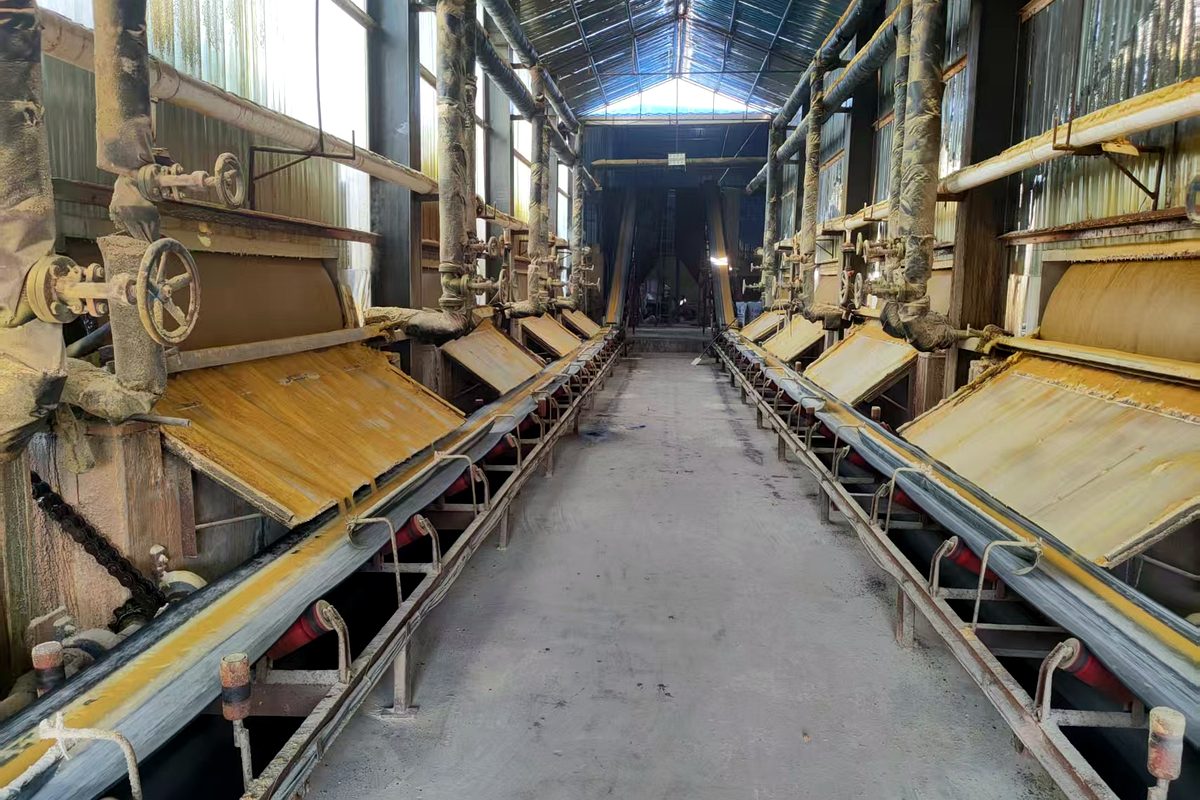
A coagulant plant is a chain: reaction, settling, dewatering, drying, scrubbing, bagging. Every stage constrains the next, and the cheapest plants we see are the ones where somebody optimised one stage and starved another.
Stage by stage, with the design parameter that actually matters and the mistake we most often find in existing plants.
01
Reaction & dissolution
Hydrochloric acid and an alumina-bearing raw material at 85–105 °C, held for two to six hours, then basified and polymerised. The design parameter is heat input per cubic metre, not vessel volume. The usual mistake is a jacket sized for heat-up but not for the endotherm during dissolution, which stretches every batch by an hour.
02
Settling
Insoluble matter leaves the liquor in long runway basins at 8–12 hours retention. The parameter is horizontal velocity, kept below 0.005 m/s. The usual mistake is a basin that is too short: it works in commissioning and fails at full rate.
03
Dewatering
Filter presses take the underflow to a cake at 30–35% solids. The parameter is cycle time, not press area. The usual mistake is a press sized on area alone, with no allowance for cloth blinding over a shift.
04
Drying
Steam-heated drum flakers turn clear liquor into 2–4 mm flake at under 3% moisture. The parameter is film thickness — everything else follows. The usual mistake is wet steam at 0.4 MPa feeding a drum specified for 0.7 MPa.
05
Gas scrubbing
Three-stage absorption takes the HCl in the dryer vapour below 10 mg/m³. The parameter is mist removal, not gas absorption. The usual mistake is a good tower connected to leaking hoods, which fails the stack test regardless.
06
Bagging
Net-weigh filling into 25 kg bags at 6–8 t/h, or 1 t jumbo. The parameter is the feeder's two-speed control. The usual mistake is a single-speed screw, which converts a 0.2% accuracy target into 0.8% giveaway.
Integration: these six stages are designed as one calculation. Dryer evaporation sets the scrubber duty; settling performance sets the dryer feed concentration; feed concentration sets the whole line's steam demand.
Configurations
Four lines we build most often.
Capacity is finished product per year on a two-shift basis. Every configuration is re-rated to your raw material and your market.
CFG-01 · LIQUID5,000–60,000 t/y
Liquid coagulant line
Reaction, settling and storage — no drying step. The lowest capital cost per tonne, and the right answer when your customers are within trucking distance.
The decision is usually commercial before it is technical. These are the numbers that settle it.
Criterion
CFG-01 Liquid
CFG-02 Solid
CFG-03 Combined
Capital cost per annual tonne
Lowest
≈2.5× liquid
≈1.8× liquid
Energy per tonne of product
Low
High (steam for drying)
Medium
Freight per tonne of active ingredient
High (water is shipped)
Low
Depends on split
Shelf life
6–12 months
24 months
Both
Market reach
Regional, by tanker
Export, bagged
Regional + export
Operating complexity
Simple
Moderate
Highest
Typical payback
2–3 years
3–5 years
3–4 years
Cost multiples are order-of-magnitude and assume the same site and utilities. Freight dominates the choice whenever the market is more than 500 km away.
Our advice in most first projects: build the liquid train, design the plot plan and the steam header for the drying stage, and add the dryer when the order book justifies it. That is CFG-01 today and CFG-03 in two years, for the price of a little extra space and a larger boiler house.
Programme
How long a line takes.
From design-basis approval to first saleable product, assuming a site that is ready and a client who returns comments on time.
Phase
Duration
Notes
Design (concept to IFC)
12–16 weeks
Critical path is client data, not drafting
Procurement & fabrication
16–24 weeks
Overlaps design from week 8
Sea freight
3–6 weeks
Depends on destination and vessel schedule
Civil works on site
8–12 weeks
Runs in parallel with fabrication
Erection
6–10 weeks
Depends on local labour and crane availability
Commissioning & trial run
3–6 weeks
Includes operator training
Total, design to product
12–16 months
Turnkey scope, one line
A single vessel or tank is 45–70 days from drawing approval. Figures exclude permitting, which is the client's responsibility and varies widely by country.
Scope
What is in a turnkey contract.
Written down at quotation stage, because scope arguments cost more than scope.