Reaction vessels
The vessel where hydrochloric acid meets alumina. Everything downstream is sized by what happens here — the batch volume, the heat-up time, and how much insoluble matter you leave for the settling stage.
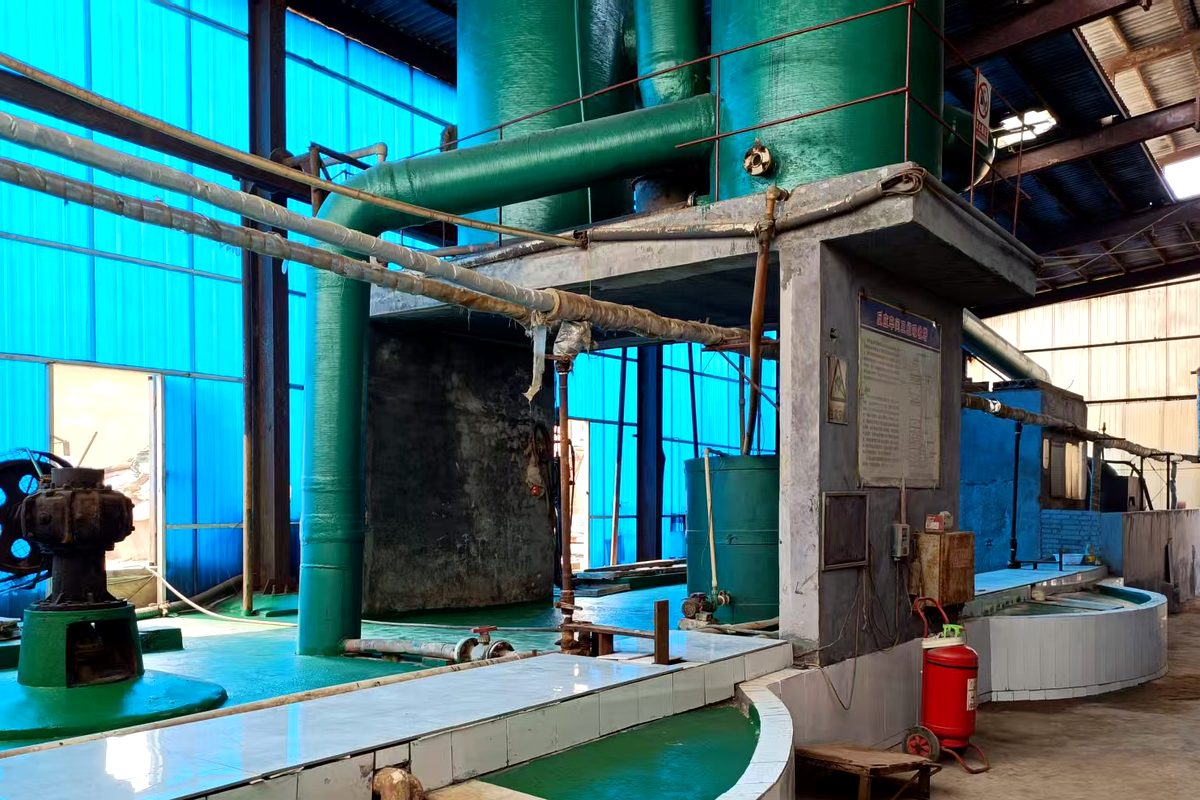
Where it sits in the line
Hydrochloric acid metering → reaction vessel (85–105 °C, 2–6 h) → basification with calcium aluminate → polymerisation hold → runway basins. The reactor sets the daily tonnage for every stage after it, which is why we size it before anything else on the drawing.
Small and mid-size plants run one vessel batch-wise at 10–30 m³. Above roughly 10,000 t/y we normally go to two to eight 30–50 m³ vessels in parallel, staggered so the drying stage is fed continuously rather than in pulses.
How it is built
- Vertical cylinder with dished ends, Q245R / Q345R plate, designed as an atmospheric or low-pressure vessel
- Jacket heating with 0.6 MPa steam, or a thermal-oil jacket when the site has no boiler or needs to run above 120 °C at atmospheric pressure
- Top-entry agitator: pedestal, cycloidal or helical gearbox, coupling, mechanical seal
- Manway, sight glass, thermometer pocket, acid inlet, solids charging port, bottom discharge valve
- Vapour outlet piped to the scrubbing header, with the vessel held under slight negative pressure so acid mist leaves through the tower, not the manway
- Internal lining selected against the actual liquor: soft rubber, vinyl-ester FRP, or acid-resistant tile
Range and specifications
| Model | Nominal volume | ID × height | Jacket area | Agitator | Typical units |
|---|---|---|---|---|---|
| GR-10 | 10 m³ | Φ2200 × 2800 | 8 m² | 5.5 kW | 1–2 |
| GR-20 | 20 m³ | Φ2600 × 3800 | 14 m² | 7.5 kW | 2–3 |
| GR-30 | 30 m³ | Φ3000 × 4300 | 19 m² | 11 kW | 2–4 |
| GR-50 | 50 m³ | Φ3600 × 5000 | 28 m² | 15 kW | 3–6 |
Volumes and unit counts are back-calculated from target output, dissolution yield and batch cycle time. The table is our standard range; the project drawing governs.
What decides the size
- 01
Batch yield before volume
Work back from daily output ÷ batches per day ÷ yield per batch, then apply a fill factor of 0.75–0.85. Generous ullage is money sitting in a steel shell doing nothing.
- 02
Unit count is about decoupling
Two 30 m³ vessels beat one 50 m³ vessel: while one reacts, the other discharges, cleans or is being maintained, and the dryer never starves.
- 03
Choose the heat source on site reality
Steam gives tighter control and even heat transfer. Without a boiler, or above 120 °C, thermal oil at atmospheric pressure avoids a boiler certificate.
- 04
Decide the lining with the temperature
Rubber is economical but dislikes thermal shock. Vinyl-ester FRP is seamless and the current default. Tile suits large, abrasive duty.
Questions we are asked
Can the shell be stainless steel instead of lined?
No. The liquor is hot 30% hydrochloric acid with high chloride content; 304 and 316L suffer chloride stress-corrosion cracking and can perforate within months. The corrosion products also carry iron into the product. The lined route is not a cost compromise, it is the only workable one.
How much can one vessel produce per day?
At 30 m³ with a five-hour batch, expect three to four batches a day — roughly 60–90 t of liquid product depending on concentration and yield. Your raw material and formulation move that number considerably, so we calculate it rather than quote it.
Can we start with one vessel and add later?
Yes, and we encourage it. We set the plot plan and pipe rack for final capacity, pour the foundation and run the main header once. Adding a vessel later means tying in a branch, not breaking concrete.