Agitator drives
The most common mechanical failure on a coagulant line is not the vessel and not the pump — it is a gearbox chosen from a table of tank volumes. Torque here is set by the impeller, the slurry density and the solids loading, and all three change during a batch.
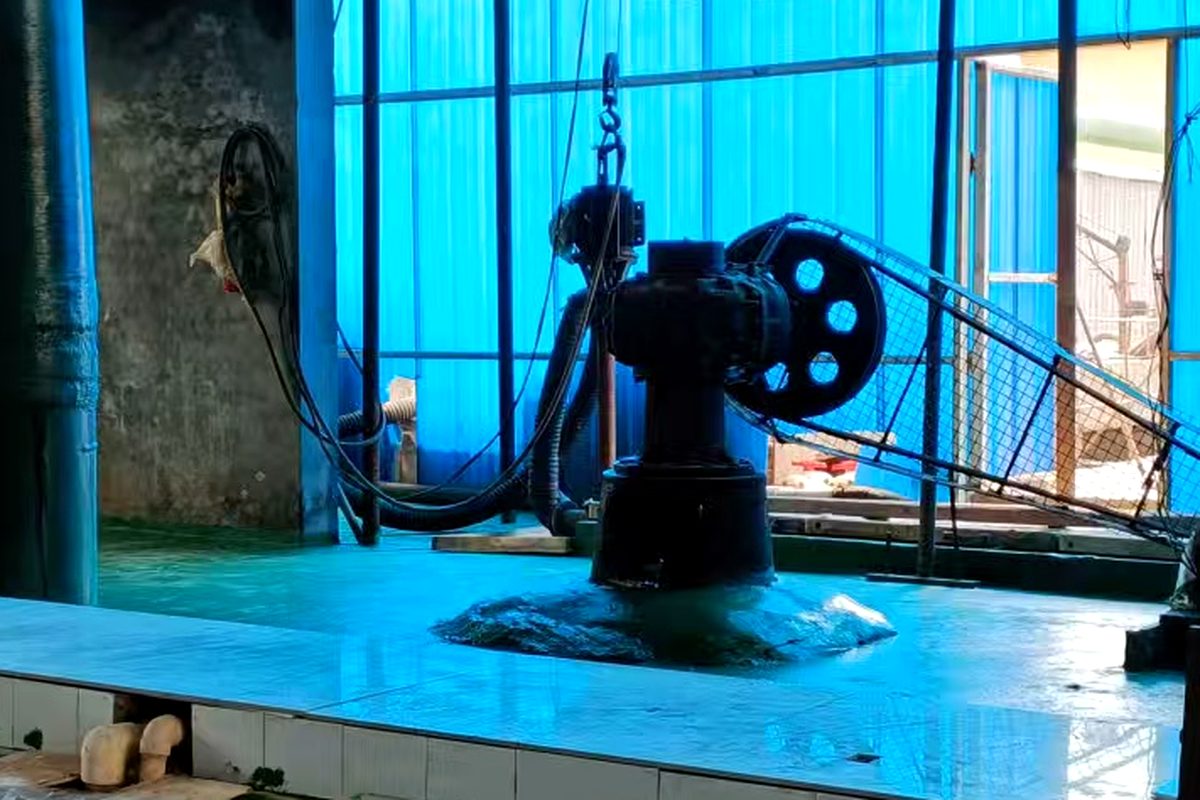
Why this part fails first
A PAC liquor runs 1.2–1.4 g/cm³, carries high suspended solids, and thickens as polymerisation proceeds. Agitating it takes far more torque than agitating water. Buyers routinely specify 5.5 kW for 10 m³ and 11 kW for 30 m³ — a pattern that feels principled and is in fact guesswork. The same 30 m³ vessel agitating dilute acid and then discharging a heavy slurry can see torque double.
We work the other way: fix the agitation duty and impeller, calculate shaft power, convert to working torque, then select the drive with a 1.5× margin and publish the figure on the datasheet.
Drive types we use
| Type | Character | Where it fits |
|---|---|---|
| Cycloidal (BLD series) | Compact, high ratio, tolerant of shock load, quiet | Standard choice for top-entry agitators |
| Hard-tooth helical (JZQ) | Higher capacity, long life, chain drive possible | Large torque, multiple vessels on one drive |
| Planetary | Short axial length, high precision | Tight headroom, special duty |
All are vertical-mounted on the vessel top with an oil-leak guard, sight glass and lifting lugs.
Range and specifications
| Vessel | Model | Output speed | Motor | Rated torque |
|---|---|---|---|---|
| 10 m³ | BLD3-23-5.5 | 80 rpm | 5.5 kW | ≈650 N·m |
| 20 m³ | BLD4-29-7.5 | 70 rpm | 7.5 kW | ≈1,020 N·m |
| 30 m³ | BLD5-35-11 | 60 rpm | 11 kW | ≈1,750 N·m |
| 50 m³ | BLD6-43-15 | 55 rpm | 15 kW | ≈2,900 N·m |
Torque figures are output torque at the coupling, before the 1.5× service margin. Selection must be re-run for slurries above 1.35 g/cm³.
Specifying one properly
- 01
Give the duty, not the tank size
Impeller type and diameter, speed, liquor density, solids content and the heaviest condition the vessel will ever see. From those four we can size it in an hour.
- 02
Watch the start-up torque
A vessel that has settled overnight needs far more torque to restart than to run. Variable-speed starting or a two-speed motor saves gearboxes.
- 03
Protect the shaft, not just the motor
A torque-limiting coupling costs a fraction of a gearbox and turns a wrecked drive into a ten-minute reset.
- 04
Match the seal to the vapour
Acid mist attacks standard lip seals. Mechanical seals with PTFE faces, or a packed gland on slow-speed duties, last considerably longer.
Questions we are asked
Is a bigger motor a safe margin?
Not on its own. Motor power and gearbox torque capacity are separate limits; an oversized motor on an undersized gearbox simply breaks the gearbox faster. Both must clear the calculated working torque with margin.
Can we run a VFD?
Yes, and on vessels that settle overnight it is worth it. Ramp up slowly to break the settled bed, then run at design speed. Above 30 kW check the motor insulation class for VFD duty.
What is the normal service life?
On a well-sized cycloidal drive in clean conditions, eight to ten years with annual oil changes. Units that fail early almost always fail on undersizing or on a settled start, not on build quality.