Tank lining
Lining is the part of a PAC plant that decides whether the vessel lasts five years or fifteen. It is also the part buyers negotiate hardest on, because it is invisible once the plant is running — until it is not.
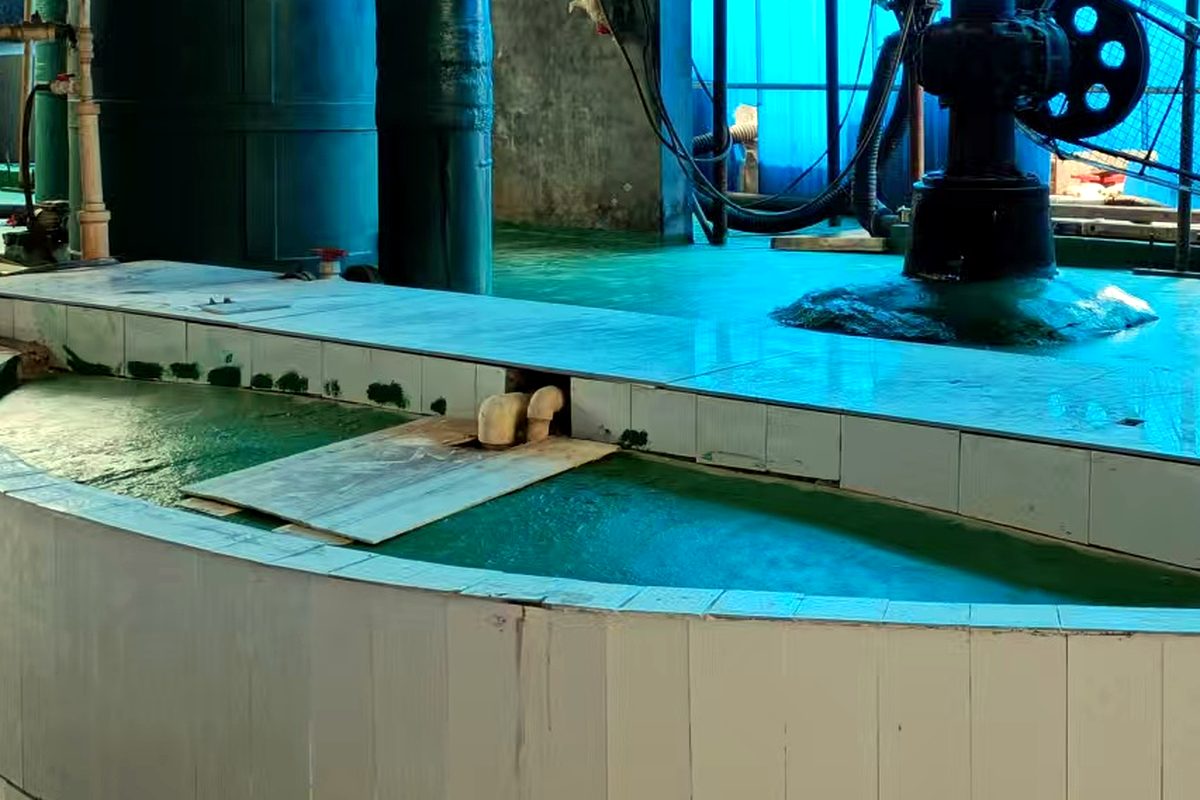
What the lining is fighting
Hot hydrochloric acid at 85–105 °C, chloride concentrations that make stainless steel crack, and thermal cycling every batch. Add abrasion from undissolved solids and the occasional mechanical damage from a charging bucket, and you have a corrosion environment that no single coat of paint survives.
Three routes, three trade-offs
| Lining | Build-up | Strength | Limit |
|---|---|---|---|
| Soft rubber | 2 ply, 3–4 mm, vulcanised in an autoclave | Excellent acid resistance, good elasticity, low cost | Poor thermal shock; joints are the weak point; site repair is difficult |
| Vinyl-ester FRP | Surface mat + 2 CSM layers + 2 woven roving, 4–6 mm | Seamless, high chemical resistance, handles temperature cycling | Requires skilled hand lay-up and full cure; quality depends on the applicator |
| Acid-resistant tile | 20–40 mm tile on resin-and-mortar bedding, membrane behind | Excellent abrasion resistance, long life in large vessels | Heavy, expensive, slow to install; tile joints need regular inspection |
For PAC reaction vessels we default to vinyl-ester FRP. Rubber is specified where cost dominates and the duty is gentle; tile where abrasion is the main mechanism.
What a proper lining job includes
- Surface preparation to Sa 2.5 with the profile recorded — most failures start here, not in the resin
- Corner radius of at least 5 mm on every internal weld and nozzle; sharp corners are where the lining cracks
- A written lay-up schedule with resin batch numbers and layer-by-layer cure records
- Spark (holiday) test at 5 kV over 100% of the surface, with the test report handed over
- Flange faces and nozzle internals lined and trimmed flush; a bare flange face is an immediate corrosion cell
- Thickness check at a minimum of five points per square metre
Specifying it without getting burned
- 01
Specify the system, not the thickness
A named resin system with its own datasheet and cure schedule is enforceable. A thickness figure alone can be met by anything.
- 02
Ask for the test record with the vessel
Spark test, thickness readings, cure check by Barcol or solvent rub, and a photograph of each stage. Three pages of paper that will save you a shutdown.
- 03
Inspect before the roof goes on
Once the last course is lined the top of a large vessel is a confined space. Most defects we find are at the manway neck and the agitator nozzle.
- 04
Plan the repair route at design stage
A lined vessel will need a patch in year eight. Detail a manway large enough to get a person and materials in, and keep a patch kit on site.
Questions we are asked
How long should a lining last?
Vinyl-ester FRP in continuous PAC duty: eight to twelve years with annual internal inspection. Rubber averages five to eight and fails first at nozzles and joints. Tile routinely exceeds fifteen.
Can the lining be repaired on site?
FRP can, with the right resin and a proper surface prep, and we supply a patch kit and procedure. Rubber cannot be vulcanised on site — it must be cut out and replaced in a workshop.
Does the outside need coating too?
Yes. The exterior sees acid mist, spillage and weather. Two coats of epoxy or chlorinated rubber on a properly prepared surface, with the shell at ambient temperature during application.