Liquid storage
Finished liquid product needs somewhere to sit, and the size of that somewhere is a commercial decision as much as an engineering one: it is the buffer between a batch process and a customer who orders on Friday for Monday.
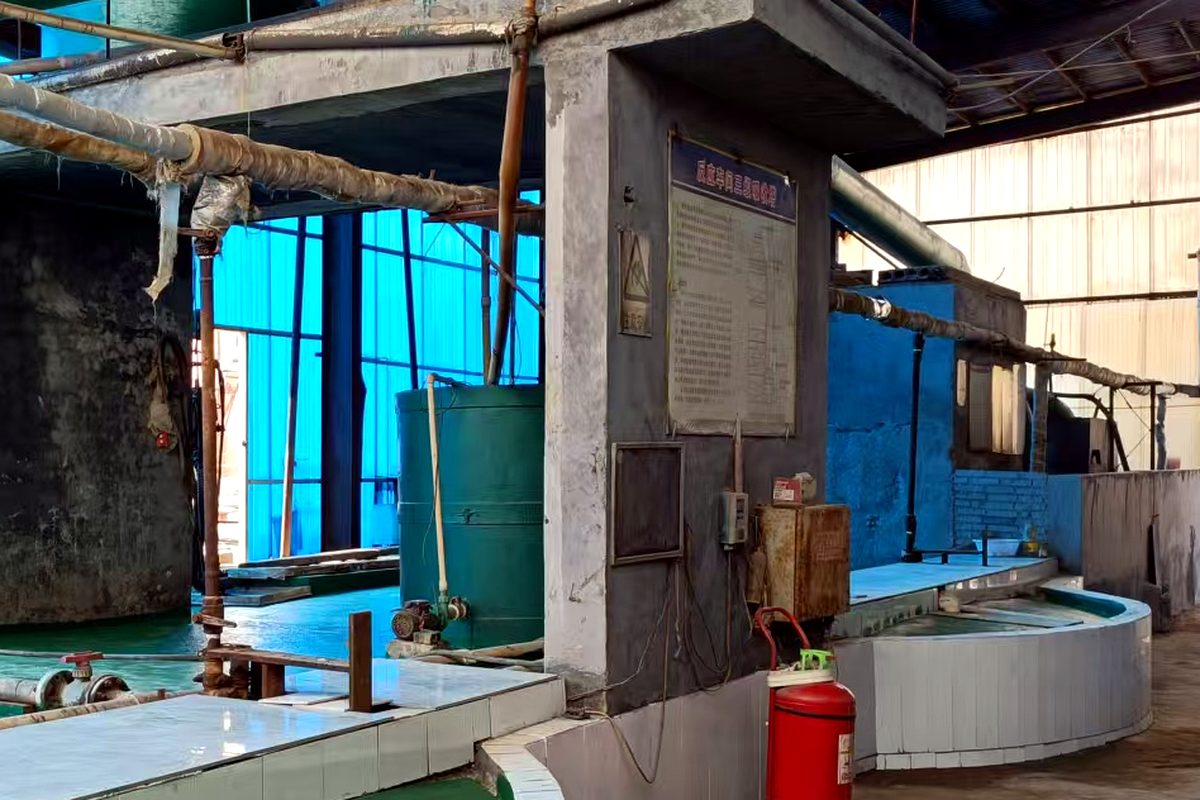
What storage has to do
Three jobs: buffer production against dispatch, let a batch homogenise before it is sold, and hold the product at a temperature where it stays stable. Under-sizing shows up as tankers waiting while a batch finishes; over-sizing ties up capital in liquid that is not yet sold.
Tank construction
- FRP tanks, hand lay-up vinyl ester, 5–8 mm wall by volume, with a top dome and flanged nozzles — the default for liquid PAC up to 100 m³
- Lined steel tanks where pressure, temperature or size rules FRP out; rubber or vinyl-ester lined, with the same test dossier as a reactor
- Cone or dished bottom with a sump and a drain valve low enough to empty the tank
- Side-entry or top-entry mixer on a timer, or recirculation through the transfer pump, to keep solids in suspension
- Level indication by radar or hydrostatic transmitter, plus a local sight glass that works when the instrument does not
- Bunded area or a double-wall tank where the authority requires secondary containment
Sizing guide
| Plant output | Storage | Buffer at full rate | Typical arrangement |
|---|---|---|---|
| 10,000 t/y | 2 × 30 m³ | ≈4 days | One product tank + one dispatch tank |
| 30,000 t/y | 3 × 80 m³ | ≈6 days | Two product, one dispatch |
| 60,000 t/y | 4 × 150 m³ | ≈8 days | Grade-segregated, common loading header |
| 100,000 t/y | 6 × 200 m³ | ≈9 days | Grade-segregated, automated loading |
Assumes liquid product at 10–12% Al2O3 and dispatch by road tanker. Export in IBCs needs additional filling and palletising space.
Details that keep it running
- 01
Put the pump where the operator is
A transfer pump tucked behind the tank is maintained once and then bypassed. Design a dry, lit, accessible pump bay with a drip tray.
- 02
Provide a sample point per tank
Quality disputes are settled with a retained sample. A simple valve and a labelled sample shelf cost almost nothing.
- 03
Think about what settles
Liquid PAC throws a fine sediment over months. A slight cone, a drain at the lowest point and a scheduled recirculation keep the last 5% of the tank sellable.
- 04
Route the vent
Acid vapour from a storage tank is a corrosion and odour problem. Vent to atmosphere above roof level, or into the scrubber header if the tank is close to the tower.
Questions we are asked
FRP or steel?
FRP below 100 m³ is cheaper, faster to deliver and immune to the chloride attack that kills mild steel. Above that, steel with a lining is more economical and easier to insulate.
How long can liquid PAC be stored?
Six to twelve months in a closed tank at ambient temperature, with some settling. Freezing destroys FRP tanks — in cold sites we insulate and trace-heat, or move to indoor storage.
Do we need a mixer in every tank?
No. A timer-driven mixer on the dispatch tank and periodic recirculation in the product tanks is enough. Continuous mixing of every tank wastes power and shear.