Runway settling basins
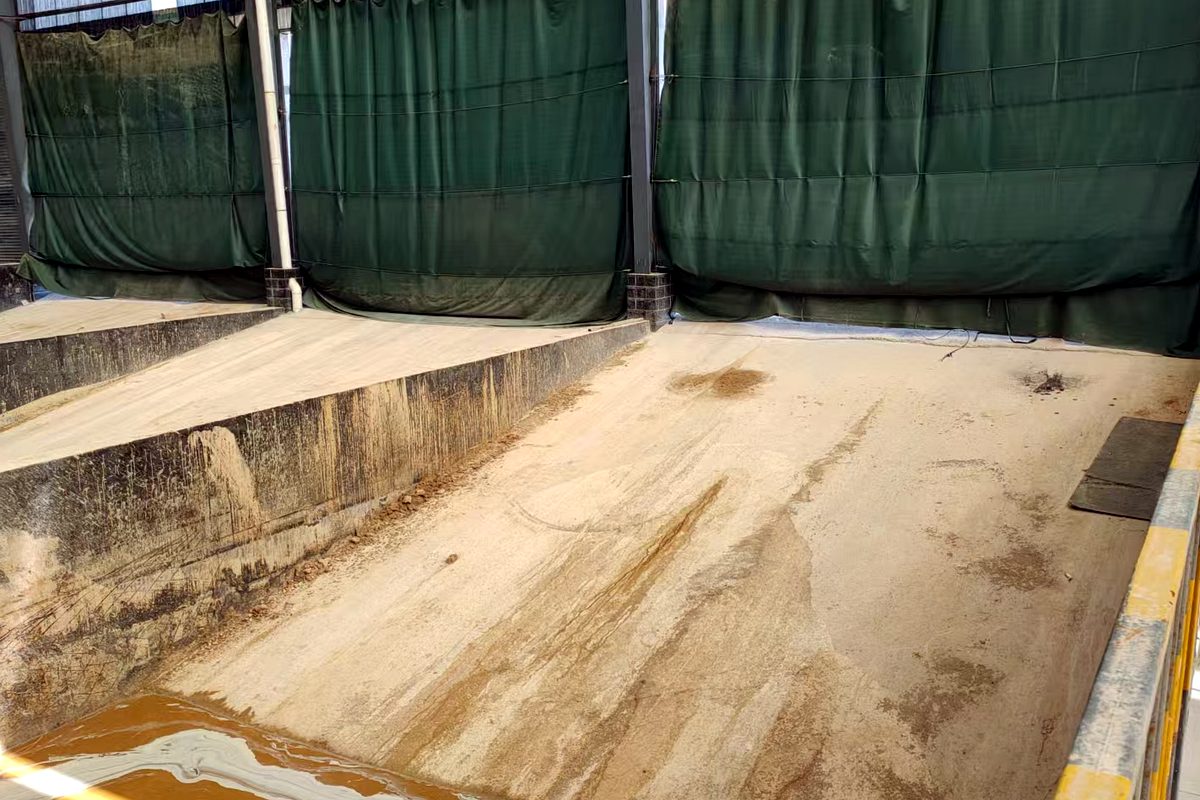
The cheapest separation stage in the plant and the one most often built too small. A runway basin is a long, shallow, baffled channel where insoluble matter settles while the liquor travels slowly from one end to the other.
Where it sits in the line
Polymerised liquor leaves the reactor carrying unreacted solids and calcium sulphate. It enters the basin at one end through a distribution weir, travels the length at a velocity low enough for particles to fall out, and leaves at the far end as clear mother liquor. Sludge is drawn from hoppers along the floor on a cycle.
It is deliberately not a thickener. There is no rake mechanism, no flocculant addition, no moving parts in the liquid. That is why it is reliable, and why it needs length rather than equipment.
Geometry that does the work
- Length-to-width ratio of at least 8:1, ideally 12:1 — short wide basins short-circuit
- Liquid depth 1.2–2.0 m; deeper basins need more length for the same settling
- Horizontal velocity below 0.005 m/s so that settled solids are not re-entrained
- Three to five baffles across the width to break the flow and stop the plume running straight to the outlet
- Floor fall of 0.5–1% towards sludge hoppers, one hopper every 6–10 m
- Inlet distribution weir and a scum board at the outlet; a stilling box before the transfer pump
Typical configurations
| Output (liquid) | Basin size | Retention | Hopper count |
|---|---|---|---|
| 10,000 t/y | 30 × 3.0 × 1.5 m | 8 h | 4 |
| 30,000 t/y | 60 × 4.0 × 1.8 m | 10 h | 8 |
| 60,000 t/y | 2 × 60 × 4.5 × 2.0 m | 12 h | 10 per basin |
| 100,000 t/y | 3 × 80 × 5.0 × 2.0 m | 12 h | 12 per basin |
Sizes assume two-shift operation and a solids load typical of the acid route. A high-solids raw material needs proportionally more volume or a pre-thickener.
Decisions we take with you
- 01
Concrete or lined steel
Concrete with an acid-resistant membrane and tile is the default above 30 m. Below that, a lined steel basin ships faster and can be relocated, which matters for leased sites.
- 02
Above ground or below
Below ground saves pumping but adds dewatering risk and makes inspection harder. Above ground on a bunded slab is easier to inspect and repair, and we usually prefer it.
- 03
How sludge leaves
Manual periodic blow-down is fine at small scale. Above 30,000 t/y we automate the hopper valves on a timer so nobody has to judge when to draw.
- 04
What happens to the sludge
It is a product, not a waste, in most plants — returned to the next batch or dried and sold. Decide the route before the basin is laid out, not after.
Questions we are asked
Can we use a circular thickener instead?
Yes, and above 60,000 t/y it is often the better answer — smaller footprint, mechanical sludge removal, more consistent underflow. It costs more in equipment and needs power and maintenance.
How often does a basin need cleaning?
A well-designed basin is desludged continuously and fully cleaned every 12–24 months. One that needs cleaning quarterly is telling you it is too short.
Does the basin need covering?
In cold climates, yes — a covered basin holds temperature and keeps rain out. Elsewhere a scum board and access walkway are enough.