Lining a tank for hot hydrochloric acid
Hot 30% hydrochloric acid with high chloride content is one of the few environments where stainless steel is the wrong answer and mild steel with a coating is the right one. The steel provides the strength; the lining provides the life. Which lining, and how well it was applied, decides whether that life is five years or fifteen.
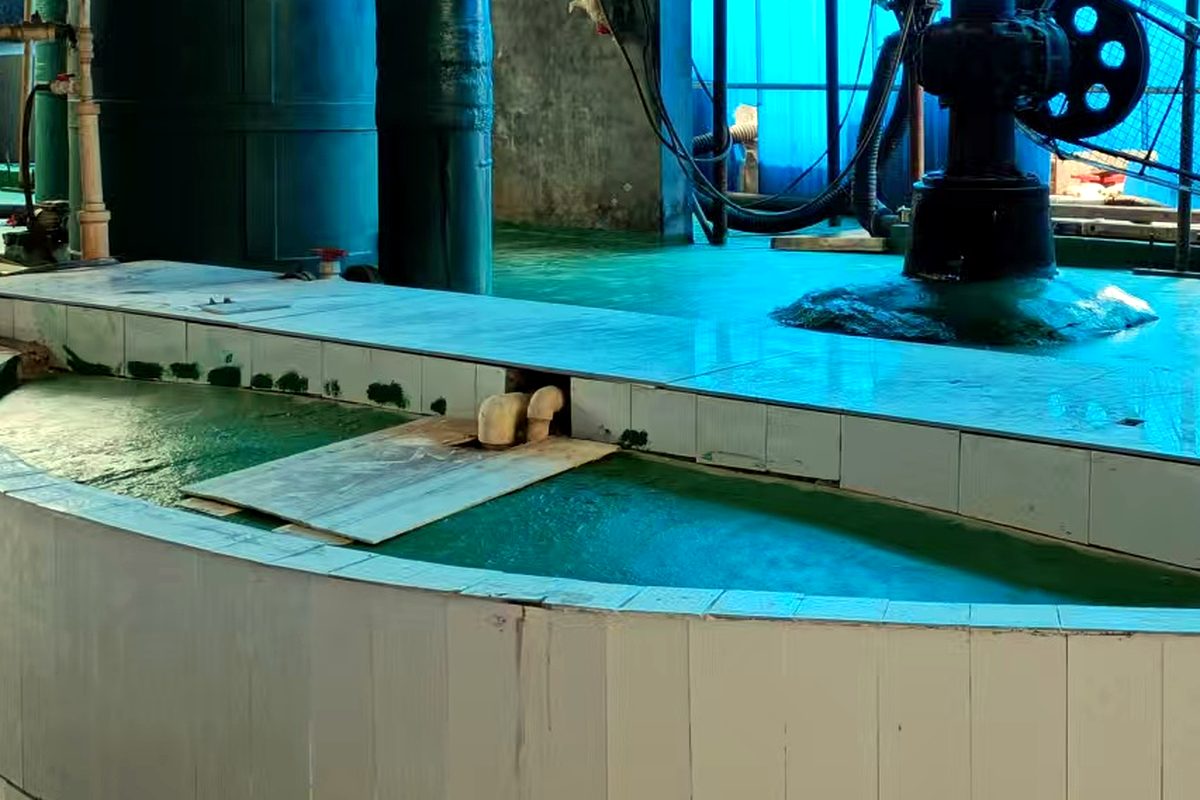
Why not stainless
Austenitic stainless steels suffer chloride stress-corrosion cracking. In a hot chloride environment under restraint — and a vessel nozzle is always under restraint — cracks initiate and propagate through the wall in months, not years. Duplex grades resist better but are still not a safe choice at 100 °C with concentrated chloride, and the cost is several times that of lined carbon steel. Titanium and Hastelloy work and cost more than the rest of the vessel.
The three systems
| System | Build-up | Survives | Fails when |
|---|---|---|---|
| Soft rubber | 2 ply, 3–4 mm, autoclave vulcanised | Acid, abrasion, moderate temperature | Thermal shock, joints, site repair |
| Vinyl-ester FRP | Surface mat + 2 CSM + 2 roving, 4–6 mm | Acid, thermal cycling, seamless coverage | Poor surface prep, incomplete cure |
| Acid-resistant tile | 20–40 mm tile on resin mortar over a membrane | Abrasion, large vessels, long life | Movement, thermal cycling, damaged joints |
For PAC reaction vessels the default is vinyl-ester FRP; rubber where cost dominates and duty is gentle; tile where abrasion is the mechanism.
Where linings actually fail
Not in the middle of a plate. Linings fail at edges, at nozzle necks, at weld spatter left under the coating, and at the transition between the shell and a flange face. A vessel can be 95% perfectly lined and still fail in year two because one nozzle was trimmed back too far and the bare steel sat in the vapour space.
- Corner radius of at least 5 mm on every internal weld — a sharp corner cracks the film on the first thermal cycle
- Surface preparation to Sa 2.5 with the profile recorded; most failures start at the substrate, not in the resin
- Flange faces and nozzle internals lined and trimmed flush, never left bare
- Lay-up records with resin batch numbers and a cure check by Barcol or solvent rub
- Spark test at 5 kV over 100% of the surface, with the report handed over
The three documents to demand
Ask for these before the vessel ships, and keep them. They are the difference between a warranty claim that is honoured and one that is argued.
- 01
The coating specification, by system name
Not a thickness. A named resin system with its own datasheet, coats and cure schedule. A thickness figure can be met by anything.
- 02
The application record
Date, ambient conditions, surface profile, batch numbers, number of coats, cure result. One page per vessel.
- 03
The test dossier
Spark test results by area, thickness readings at defined points, visual inspection of every nozzle. Photographs of each stage, dated.
Planning for the repair
Every lined vessel needs a patch eventually. Design the manway so a person and materials can get in, specify a patch kit at commissioning, and write the repair procedure into the O&M manual. A vessel that cannot be repaired in place is a vessel that will be replaced.