HCl scrubbing: what the outlet limit actually requires
Acid mist is the reason perfectly good scrubbing towers fail stack tests. The gas-phase hydrogen chloride is easy: water absorbs it readily, and a single packed bed with circulating dilute acid will take the concentration down by an order of magnitude. The mist is a different problem, and it is the one that produces the visible plume.
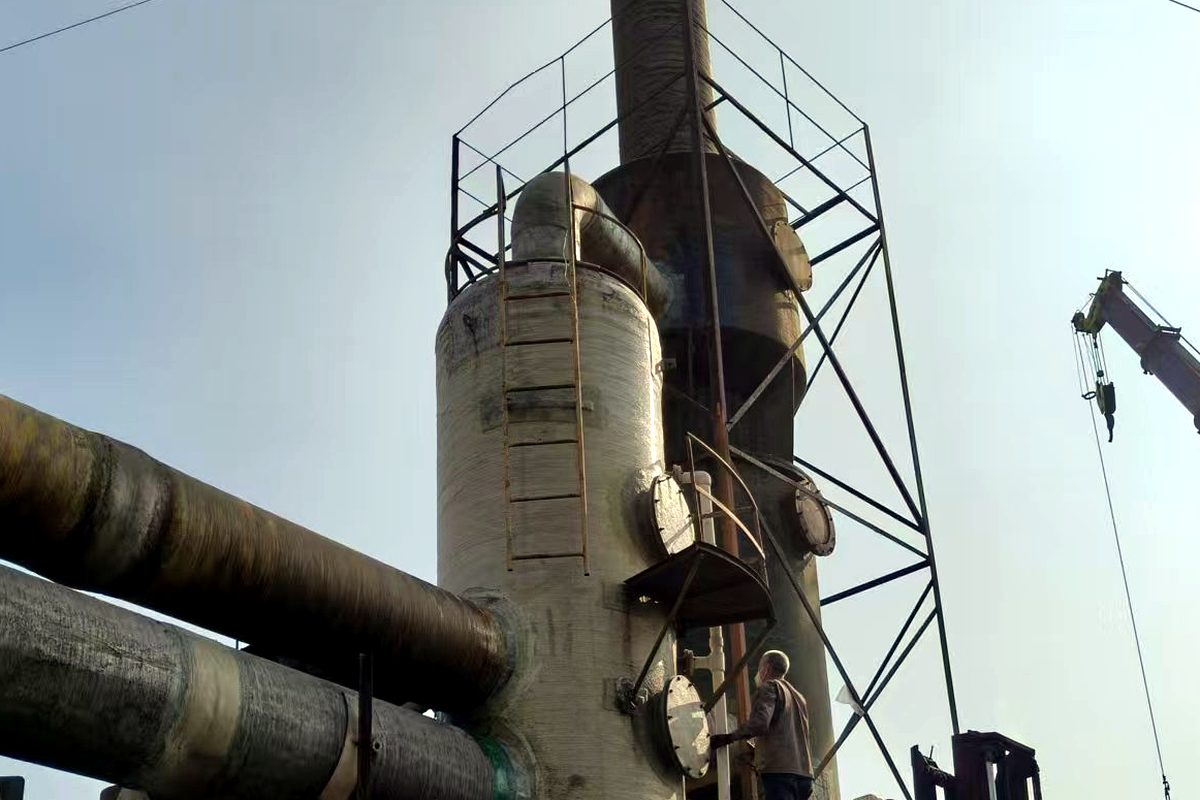
Two things are leaving the dryer
The vapour from a drum dryer carries hydrogen chloride in two forms: dissolved in the water vapour as a gas, and as sub-micron droplets of hydrochloric acid formed when the vapour cools in the duct. The first behaves like a gas and diffuses into the liquid film on the packing. The second behaves like a particle and follows the streamlines straight through the bed.
This is why a two-stage tower can measure well on a gas-phase instrument and produce a visible plume at the same time. The mass that fails the test is not the mass the packed bed was designed to remove.
What each stage is for
| Stage | Mechanism | Removes | Typical outlet |
|---|---|---|---|
| Quench / pre-cool | Direct contact with circulating liquid, gas cooled below 60 °C | Coarse mist, heat load | — |
| Packed absorption | Gas dissolves into the liquid film on the packing surface | Gas-phase HCl | 50–150 mg/m³ |
| Mist elimination | Chevron or candle filter, inertial capture of droplets | Sub-micron acid mist | ≤10 mg/m³ |
| Alkali polish (optional) | Caustic circulation on a second bed | Residual gas and mist for tight limits | ≤5 mg/m³ |
Outlet figures assume design gas flow, a working demister wash and correct liquid distribution. Any one of those failing moves the number by an order of magnitude.
The four reasons a good tower fails
- 01
The demister is blinded
A chevron or candle element that is never washed accumulates salts and dust until the gas finds a path around it. It is the single most common failure and it is a maintenance issue, not a design one.
- 02
The hoods leak
A tower sized for 10,000 m³/h connected to hoods that admit 4,000 m³/h of room air is a tower running at 140% of design. Capture at the hood comes before treatment in the tower.
- 03
The liquid distributor is unbalanced
Half the packing runs dry and the effective bed height halves. A distributor with blocked holes looks fine from the platform.
- 04
The fan was selected on the catalogue
System resistance rises as the packing ages and the ductwork fouls. A fan with no margin delivers less flow, velocity drops, and capture at the hood fails.
Designing to a number
The design sequence we use is: count every hooded source, add 15% for leakage and future tie-ins, set the tower diameter on a superficial velocity of 1.2–1.8 m/s, size the packing for the inlet concentration and the outlet limit, then specify the demister and its wash system as a separate duty. The fan is selected last, on the whole system, with margin.
That order matters. When the tower is chosen from a table and the fan is chosen afterwards to fit the budget, the plant gets a tower that is slightly too small and a fan that is slightly too weak — and the stack test finds both.